CNN —
For years, Egyptologists have hotly debated how the massive pyramids of ancient Egypt were built more than 4,000 years ago. Now, a team of engineers and geologists brings a new theory to the table — a hydraulic lift device that would have floated the heavy stones up through the middle of Egypt’s oldest pyramid using stored water.
Ancient Egyptians built the Step Pyramid for Pharaoh Djoser in the 27th century BC, and it was the tallest structure at the time, coming in at about 62 meters (204 feet) tall. But how exactly the monument was erected, with a number of stones weighing in at 300 kilograms (about 661 pounds), has remained a centuries-old mystery, according to the study published Monday in the journal PLOS One.
“Many detailed publications have discussed pyramid-building procedures and provided tangible elements, but these usually focus on more recent, better-documented, and smaller pyramids of the Middle and New Kingdoms (1980 to 1075 BC),” said lead author Dr. Xavier Landreau, CEO of Paleotechnic, a privately owned research institute in Paris that
“The techniques involved could include ramps, cranes, winches, toggle lifts, hoists, pivots, or a combination of these methods,” he added in an email. “But what about the Old Kingdom pyramids (2675 to 2130 BC), which are much bigger? While human strength and ramps may be the sole construction force for small structures, other techniques may have been used for large pyramids.”
Using an interdisciplinary approach, the new paper was the first to report a system consistent with the Step Pyramid’s internal architecture, the authors wrote.
A complex water treatment system drawing upon local resources would have allowed for a water-powered elevator within the pyramid’s internal vertical shaft. Some type of float would have raised the heavy stones up the middle of the pyramid, according to the study.
While the theory is an “ingenious solution,” some Egyptologists aren’t convinced, as a more widely believed theory is that the ancient Egyptians used ramps and haulage devices to put the heavy blocks in place, said Egyptologist Dr. David Jeffreys, a retired senior lecturer in Egyptian archaeology at the University College London who was not involved with the study. Here’s what experts have to say on the new theory.
Egypt’s desert was once savannah
By analyzing available data, including paleoclimatology, the study of ancient climates and archaeological data, the study team suggested that water from ancient streams flowed from the west of the Saqqâra plateau into a system of deep-water trenches and tunnels that surrounded the Step Pyramid.
The water also would have flowed into the Gisr el-Mudir — a rectangular limestone structure that is a massive 650 by 350 meters (2,133 feet by 1,148 feet) — which would have acted as a check dam. This device, which was previously thought to be a fortress, a celebration arena or a cattle enclosure, would control and store water from heavy floods, as well as filter out sediment and dirt so they would not clog the water passageways.
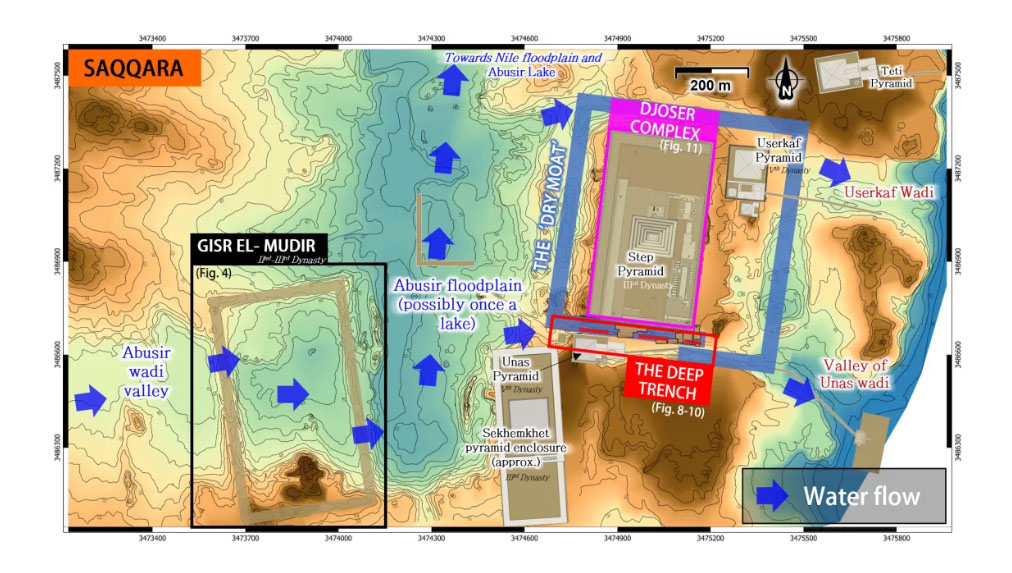
The theorized water treatment system would not only allow for water control during flood events, but also would have “ensured adequate water quality and quantity for both consumption and irrigation purposes and for transportation or construction,” said study coauthor Dr. Guillaume Piton, a researcher with France’s National Research Institute for Agriculture, Food and Environment, or INRAE, based at the Institute of Environmental Geosciences of the University Grenoble Alpes.
The authors pointed to several prior studies that found the Sahara Desert saw more regular rainfall thousands of years ago than it does today. The landscape would instead have resembled a savannah, which could support more plant life than arid desert conditions. However, there is debate on when exactly the climate conditions were wetter.
There might have been enough water to support a system such as the hydraulic lift, said Dr. Judith Bunbury, a geoarchaeologist at the University of Cambridge in London who was not involved with the new study. She pointed to past research that found rainwater gutters being built and used in the Old Kingdom, as well as past research thatlooked at the diet of birds during the time, which had consisted of wetland species such as frogs.
read more on https://edition.cnn.com/2024/08/05/science/egypt-pyramid-hydraulic-lift-technology-theory/index.html