The court processes were filed on December 23, 2024 on the face of the records, then the story blew up the following day about how a young lawyer had taken on a popular A-Class Senior High School (SHS) in a case of stated religious discrimination.
The court papers revealed the name of the lawyer as Shafic Osman and Muslims in their hundreds quickly posted congratulatory messages for his singular action.
So, Iqra Today decided to dig into who Shafic was. A simple google search of his name landed us his profile as an academic on the website of the institution he is currently studying with – The London School of Economic (LSE).
The profile below focuses largely on the academic footprints of Shafic zooming in further on his current pursuits.
Shafic Osman is an MPhil/PhD student at the LSE. Shafic’s research seeks to interrogate the legal and political economy issues vexing sovereign debt governance in post-colonial states in Africa. At the core of Shafic’s study is an interest in sustainably financing Africa’s socioeconomic development, as the era of “cheap money” comes to an end.
Shafic holds an LL.M (Distinction) from the University of Warwick, and two undergraduate degrees in Law and Economics from the University of Ghana.
Thesis title
‘Moving on from “yentua”: Debt Governance in an African State’
Research interests
Sovereign Debt Governance, International Financial Architecture, Political Economy of Ghana.
Called to the Bar in 2021, Shafic is a member of the Ghana Bar Association (GBA). He has also previously worked in the Office of the outgoing Second Lady, Samira Bawumia.
He is an alumnus of Presbyterian Boys SHS, Legon.
The case against Wesley Girls SHS
The action invokes the original jurisdiction of the Supreme Court under Articles 2(1)(b) and 130(1)(a) of the 1992 Constitution.
Shafic Osman is seeking several declarations and orders against the Board of Governors of Wesley Girls’ Senior High School, the Ghana Education Service (GES), and the Attorney General, citing violations of constitutional rights of Muslim students in the school.

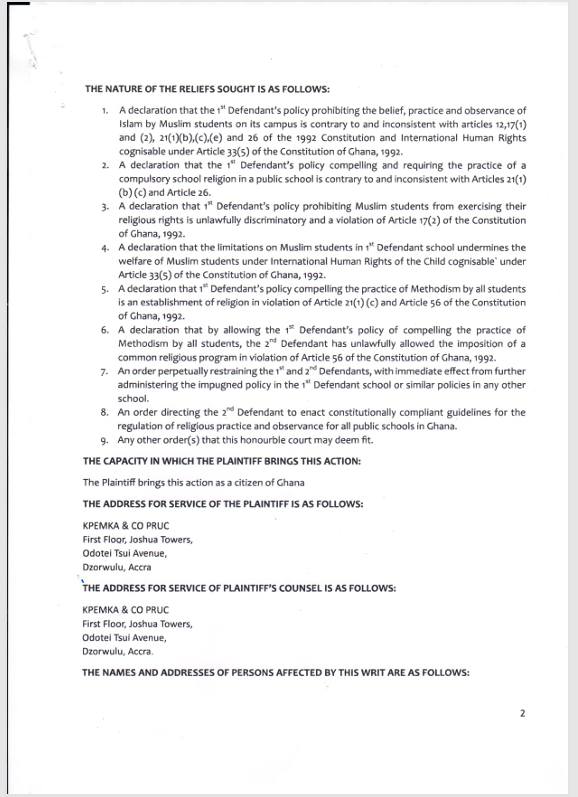
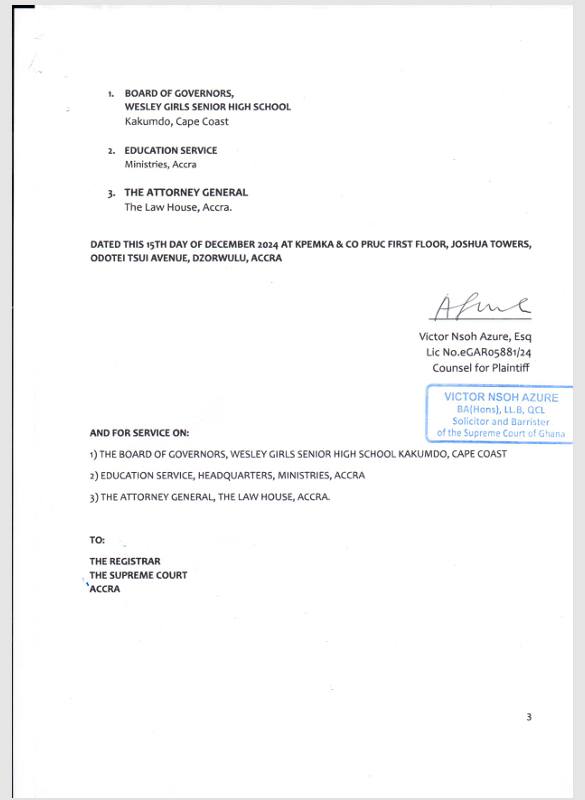
The reliefs sought aim to challenge policies that allegedly restrict the religious practices of Muslim students and compel adherence to Methodist practices.
The suit is asking the Supreme Court to declare that the school’s policy prohibiting Muslim students from practising and observing their faith violates Articles 12, 17(1) and (2), 21(1)(b), (c), (e), and 26 of the 1992 Constitution, as well as international human rights laws under Article 33(5).
It also seeks a declaration that requiring students to partake in a compulsory school religion contravenes Articles 21(1)(b), (c), and Article 26 of the Constitution.
The plaintiff argues that prohibiting Muslim students from exercising their religious rights is discriminatory and violates Article 17(2) of the Constitution.
The suit asserts that the restrictions imposed on Muslim students undermine their welfare, contravening international child rights recognized under Article 33(5) of the Constitution.
The plaintiff claims that the Ghana Education Service has unlawfully enabled Wesley Girls’ SHS to impose a common religious program, violating Article 56 of the Constitution.
The lawsuit calls for an immediate end to the contested policies and an order directing the GES to develop constitutionally compliant guidelines for regulating religious practice in public schools.
Wesley Girls’ Senior High School, a prestigious Methodist institution, has faced criticism in recent years for policies perceived as restrictive towards students of non-Christian faiths.
The Ghana Education Service had previously intervened in similar disputes, calling for religious tolerance in public schools.
This case brings to light the broader question of balancing institutional traditions with Ghana’s constitutional mandate for inclusivity and respect for diverse beliefs.
The public eagerly awaits the Supreme Court’s judgment, which will undoubtedly have far-reaching implications for Ghana’s democratic principles and human rights landscape.